
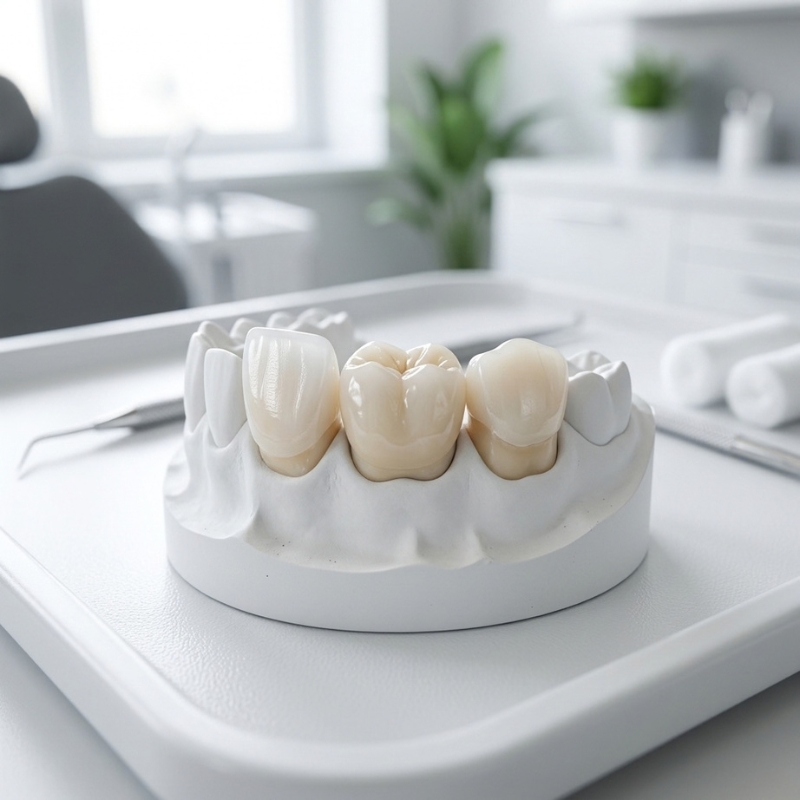
If you have been quoted for veneers or a crown and are wondering why the numbers vary so much, the short answer is that these are priced per tooth, and the material is the single biggest factor in what you pay. This article explains what veneers, crowns and bonding each are, why the choice of material changes the price so much, why a quote for one tooth is not simply multiplied for six, and what a proper quote should include. Blue Mountains Dental & Implant Centre provides crowns, bridges and veneers at our Wentworth Falls clinic, and the aim here is to help you make sense of the range of prices you have seen before you commit to anything.
Veneers and crowns are quoted per tooth, and the material is the biggest single factor. Composite is applied directly in one visit and costs least; porcelain is made in a laboratory, takes two visits and costs more. A crown covers the whole tooth, so it generally sits above a veneer on the same tooth.
Veneer, crown or bonding: what each one is
Before comparing prices, it helps to know what each of these actually does, because they are not interchangeable, and the choice is usually driven by how much of the tooth needs attention.
A veneer is a thin facing bonded to the front surface of a tooth. It changes the colour, shape or appearance of a tooth that is largely sound underneath, which is why veneers are mostly used on the front teeth people see when they smile. Because a veneer covers only the front, it is a more conservative option that leaves most of the natural tooth in place.
A crown covers the whole tooth, not just the front. It is used when a tooth is more significantly damaged, heavily filled, cracked or weakened, for example after root canal treatment, and needs protecting rather than just improving in appearance. Covering the entire tooth means more preparation of the tooth beneath.
Bonding uses composite resin applied directly to the tooth to repair a chip, close a small gap or make a minor change. It is the least invasive and is done in a single visit.
The general rule is that the more of the tooth that is damaged, the more coverage is needed, which moves you from bonding toward a veneer and then a crown. If you want the fuller comparison of when each is the right call, our article on veneers compared with crowns and bonding walks through the choice in detail.
Why the material changes the price so much
The biggest driver of what you pay is whether the work is done in composite or porcelain, and the difference comes down to how each one is made.
Composite is applied directly onto the tooth in the chair. The dentist shapes and sets the resin tooth-side in a single appointment, with no outside laboratory involved. That means one visit and less overall time and cost. The trade-offs are that composite is a softer material than porcelain, and because it is porous it can pick up staining over time from coffee, tea, red wine and smoking, in a similar way to natural teeth.
Porcelain is made in a dental laboratory to fit your tooth precisely, then bonded on at a second appointment. So the price includes the laboratory work and the extra chair time across two visits, which is the main reason it costs more than composite. In return, porcelain is a harder, more hard-wearing material, and its glazed surface resists staining far better than composite does, holding its appearance over time.
So the price difference is not arbitrary. With composite you are paying for a single-visit, chair-side result at a lower cost, accepting a softer material that may stain. With porcelain you are paying for laboratory-made work across two visits, a more durable and stain-resistant result at a higher cost. Which represents better value depends on the tooth, where it is in your mouth, and what you want from it, which is exactly what a consultation is for.
Why a quote for one tooth is not a quote for six
A common surprise is that the cost of doing one tooth does not simply scale up or down in the way you might expect, and there is a good reason for that with cosmetic work on the front teeth.
When you are improving the appearance of the teeth that show when you smile, the work is usually planned as a set rather than tooth by tooth, so the shade and shape match across all of them. A single new veneer sitting next to untouched natural teeth can stand out if its colour or shape does not blend, which defeats the purpose. Getting an even, natural-looking result across the front teeth means planning them together, considering how each relates to the ones beside it.
This is why a per-tooth figure can be misleading if you are picturing cosmetic work on several front teeth. The planning, the shade matching and the shaping are done across the whole set to make them look consistent, so the quote reflects the result as a whole rather than a simple count of individual teeth. For a single damaged back tooth that needs a crown, the picture is different again, since matching a set is not the issue there. Your dentist will tell you what is actually needed to get the result you are after.
What the quote should include
A quote is easier to compare and trust when you know what it should cover, so it is worth checking these are accounted for rather than added later:
- The consultation, where your teeth are assessed and the plan is worked out.
- Any imaging needed, such as X-rays or scans, to see what is happening with the tooth and plan the work.
- A temporary, where one is needed, to protect and cover the tooth while a laboratory crown or veneer is being made between appointments.
- The fitting appointment, where the finished crown or veneer is bonded into place.
- Any adjustment afterwards, since a small tweak to the bite or the fit is sometimes needed once it is in.
Asking what is and is not included means you are comparing like with like, rather than a lower figure that leaves several of these out and grows once the work is underway. A clear, itemised quote tells you a fair amount about how the practice works, too.
What to ask before you commit
A few direct questions before you go ahead will tell you most of what you need to know:
- Which material is being quoted? Confirm whether it is composite or porcelain, since that is the main driver of both cost and how the result behaves over time.
- How many visits will it take? A chair-side composite is usually one visit, while laboratory-made porcelain is generally two, which affects your time as well as the cost.
- Is a temporary included? If a laboratory crown or veneer is being made, check whether a temporary to wear in between is part of the quote.
- What happens if the shade is not right? Ask how a colour or shape that does not match is handled before the work is finalised.
- What does the replacement timeline usually look like? Understand how the work is maintained and when it might eventually need redoing, so there are no surprises later.
Frequently Asked Questions
Why are porcelain veneers more than composite?
Porcelain is made in a dental laboratory and fitted at a second appointment, so there is laboratory work and extra chair time. Composite is shaped directly on the tooth in one visit.
Is a crown more than a veneer?
Generally yes on the same tooth, because a crown covers the whole tooth rather than the front surface and usually involves more preparation and laboratory work.
Do I need to do all my front teeth at once?
Not always, but cosmetic work is often planned as a set so the shade and shape match across the teeth people actually see. Your dentist will tell you what is needed to get an even result.
Does private health cover contribute to veneers?
Cover varies by policy and purely cosmetic work is often treated differently from restorative work. Check your own policy, because the distinction changes what you get back.
What it comes down to
The cost of veneers and crowns is driven mainly by the material and the amount of coverage: composite applied in one chair-side visit costs least, porcelain made in a laboratory across two visits costs more, and a crown covering the whole tooth generally sits above a veneer on the same tooth. Cosmetic work on the front teeth is also planned as a set, so a single per-tooth figure does not always tell the full story. If you would like a written quote, book a cosmetic consultation at our Wentworth Falls clinic.