
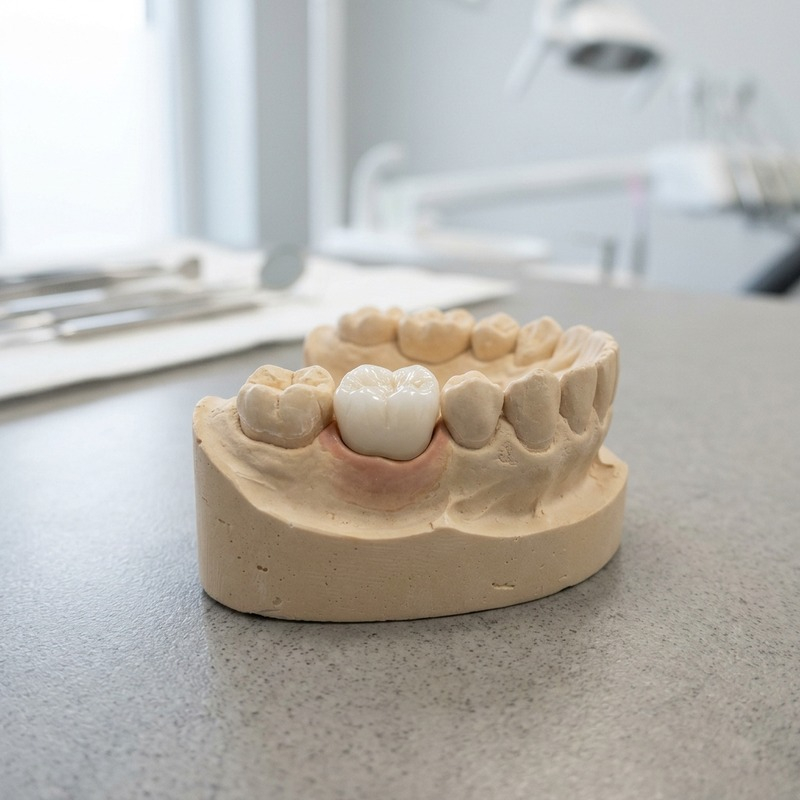
How long do dental crowns last? General patient information published by Healthdirect describes crowns as a long-lasting restoration rather than a permanent one, with lifespans commonly quoted in a range of roughly five to fifteen years and many crowns continuing to do their job beyond that. I find that range surprises people, because most of us would rather be given one tidy number. The reason there is no single number is straightforward. A crown is not a standalone object sitting in your mouth on its own. It is a cover cemented over a tooth you still own, so the working life of the restoration depends on the health of that tooth, the material chosen, and what happens to it every day. Once you can picture how a crown is built up over a prepared tooth, the rest of this becomes much easier to follow.
What the published lifespan ranges actually mean
The figures quoted by healthdirect and similar patient education sources are averages drawn from very large groups of people with very different mouths, diets and habits. They are a planning guide, not a prediction about any individual. A crown on a back molar in someone who clenches heavily through the night sits at one end of that distribution. A crown on a front tooth in a stable bite, cleaned carefully every day, sits at the other. Neither result is guaranteed, and no article can tell you where your own crown will land.
So when someone asks how long dental crowns last, the honest answer is that the range is wide because the conditions are wide. It also helps to separate two things that often get bundled together under the phrase “the crown failed”. Sometimes the restoration itself is the problem, because it has chipped, fractured or lost its cement seal. Other times the crown is perfectly intact, and the tooth or gum underneath has changed. The two situations have different causes and different solutions, and only a clinical examination with radiographs can tell them apart.
The material a crown is made from
Crowns are made from a few broad families of material, and each behaves differently over time. All ceramic and porcelain crowns are chosen largely for appearance and are widely used on teeth that show when you smile. Porcelain bonded to a metal substructure combines a tooth coloured outer surface with a stronger core. Full metal and gold crowns are the least visually discreet option but have a long history of standing up to heavy chewing forces, which is why they still turn up on back teeth. Newer high strength ceramics sit somewhere in between.
None of these is the right answer for every tooth, and none of them is a lesser version of another. The choice is a clinical one that balances where the tooth sits in the mouth, how much natural tooth structure is left to build on, how hard you bite and what you want the tooth to look like. That is a conversation to have with your own dentist rather than a decision to make from an article.
The condition of the tooth underneath
This is the factor people underestimate most. The crown covers the tooth, but the junction where the crown meets the tooth, usually called the margin, is still exposed to plaque, acid and everything else going on in your mouth. Decay can start at that margin and travel underneath, and because the crown hides it, the problem can progress further than it would on an uncovered tooth before anything is noticeable.
Gum health matters for the same reason. If the gum recedes, more of the margin becomes exposed and harder to keep clean. The amount and quality of tooth left after preparation also plays a part, which is why the question of whether a cracked tooth can be saved is usually settled before a crown is even discussed. A crown built on a tooth with a strong, healthy foundation has more going for it than one asked to hold together a tooth that was already heavily compromised.
Grinding, clenching and everyday chewing forces
Teeth are built to handle considerable force, and so are crowns, but repetition takes a toll. Habitual nighttime grinding, known as bruxism, loads a restoration thousands of times over in a way that normal chewing does not. Daytime clenching under stress does something similar. Over months and years that can show up as wear facets, small chips at the edge, or a cement seal that eventually gives way.
Other habits do the same kind of damage more suddenly. Chewing ice, biting fingernails, opening packaging with your teeth or crunching down on hard lollies and unpopped popcorn kernels are all common ways a restoration gets fractured in a single moment. If you know you grind or clench, that is worth raising at an appointment, because there are protective options a dentist can assess you for.
Keeping the margin clean
Day to day maintenance is not complicated, but it is the part that quietly decides a lot. Brushing twice a day with a fluoride toothpaste and cleaning between the teeth daily keeps plaque off the margin, which is exactly where trouble tends to start. Crowned teeth need cleaning between them just as much as natural teeth do, and plenty of people skip that side because the crown feels solid and finished.
Professional care sits alongside that. A routine check up and clean gives a clinician the chance to look at the margin, check the gum around it and take radiographs where they are needed, which is how changes under a crown tend to be picked up before they become painful. How often that should happen is an individual judgement based on your own risk, not a fixed interval that suits everyone.
Changes worth mentioning at your next appointment
You are not meant to diagnose your own crown, and this article cannot tell you whether yours needs attention. What you can do is notice change and report it. Things patients commonly describe include a crown that feels different when they bite, new sensitivity to cold or sweetness in that tooth, a rough edge they can feel with their tongue, an odd taste or odour around the tooth, a gum that bleeds there when nothing else does, or a dark line appearing at the gum margin. Any of those is a reason to book an examination rather than wait and see.
Pain, swelling or a crown that has come loose or come off entirely should be treated as more urgent. A crown that is off does not just need recementing on a whim, because the exposed tooth underneath is vulnerable in the meantime.
Frequently asked questions
How long do crowns last before they need replacing?
General patient information from sources such as healthdirect puts most crowns in a range of roughly five to fifteen years, with many lasting longer. That is a population average rather than a schedule. Crowns are not replaced on a timer, they are replaced when an examination shows a clinical reason to, such as decay at the margin, a fracture or a failed seal.
Can a tooth decay under a crown?
Yes. The crown itself does not decay, but the natural tooth at and below the margin can. Because the restoration covers the tooth, early decay there is often not visible or noticeable, which is one of the main reasons crowned teeth are still examined and radiographed as part of ongoing care.
Is it better to pull a tooth or get a crown?
There is no universal answer, and it is not a decision that should be made from general reading. It depends on how much sound tooth structure remains, the state of the root, nerve and surrounding bone, your bite and your overall health. Preserving a natural tooth is often preferred where it is realistically restorable, but only an in person assessment with imaging can establish whether that applies to a particular tooth.
What shortens the life of a dental crown?
The common contributors are decay or gum disease developing at the margin, grinding and clenching, biting hard objects, trauma, plaque left between teeth and gaps in ongoing professional care. Several of these are modifiable, which is why habits and hygiene come up so often in this conversation.
Have your crowns looked at properly
This article is general information and is not a substitute for individual dental advice. If you have a crown that feels different, has been in place for many years, or you simply want to know how your existing restorations are holding up, the team at Blue Mountains Dental & Implant Centre has been caring for patients in the Blue Mountains for 30 years and can assess it in person. Get in touch to arrange an appointment.