
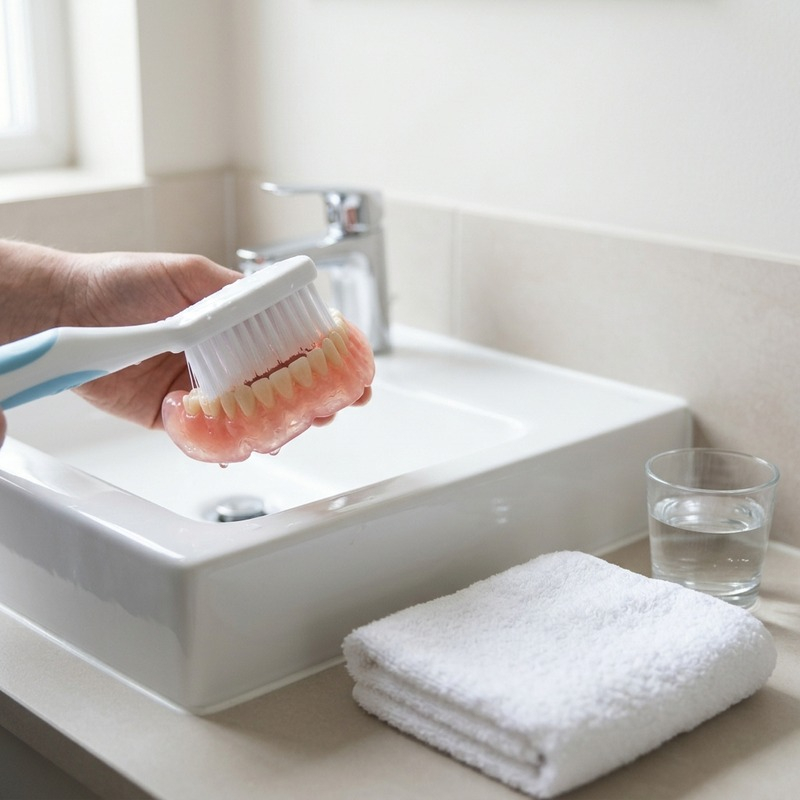
If you want to know how to clean dentures properly, the general routine described by patient information from NSW Health and SA Dental is simpler than most people expect. Take them out, rinse away loose food, brush every surface with a soft brush and water over a towel or a basin of water, rinse them again, and give your gums and mouth a clean while the dentures are out. Then store them somewhere safe and moist overnight. What I notice is that the technique is rarely where things go wrong. People come unstuck on the details, like using the wrong brush, reaching for the toothpaste they use on natural teeth, or leaving the dentures dry on a bathroom shelf. Those small habits are also what make the difference between a set of dentures that still fits well after years of use and one that no longer feels right.
Why dentures need their own routine
Dentures collect plaque in exactly the way natural teeth do, and acrylic has microscopic texture that bacteria and fungi settle into happily. Left alone, that builds into a film, then into a hard deposit that a brush can no longer shift. The consequences are not only cosmetic. Public dental health information consistently links poor denture hygiene to sore, inflamed tissue under the plate, to bad breath, and to staining that becomes permanent.
Understanding how to clean dentures is therefore about protecting the tissue underneath as much as the appliance itself. There is a second reason the routine matters. Dentures sit directly against gum tissue that needs a rest and a clean of its own. If the plate is never out, that tissue stays covered and unaired for twenty-four hours a day, which is not what it is designed for.
The daily clean, step by step
General guidance from NSW Health and SA Dental follows the same basic shape. Remove the denture and rinse it under running water to clear any loose food. Then brush all surfaces, inside and out, with a soft bristled brush, including the side that sits against your gums and palate where plaque is easiest to miss.
Do this over a folded towel or a basin partly filled with water. Acrylic is more brittle than it looks, and a denture dropped onto a hard sink or tiled floor from chest height can fracture. Rinse thoroughly afterwards so nothing is left on the surface.
While the denture is out, clean your mouth as well. Brush any remaining natural teeth, and gently clean your gums, tongue and palate with a soft brush or a clean damp cloth. This is also the moment to notice anything that has changed, which matters because a check of your gums and remaining teeth is part of looking after dentures and not separate from it.
Rinsing the denture after meals during the day helps too, particularly if food tends to get trapped under the plate.
What to use and what to keep away from it
This is where general guidance is firm, and where I would rather point you to your own dentist than name a specific product. Public dental services advise cleaning dentures with a soft brush and water, or with a cleaner specifically intended for dentures. Which cleaner or soaking agent suits your particular denture depends on what it is made of, whether it has metal components and what your own mouth and health circumstances are, so that choice belongs with the clinician who provided it.
What the published guidance is clear about is what to avoid. Ordinary toothpaste is generally not recommended, because many are abrasive enough to scratch acrylic, and those scratches then hold stain and plaque. Hot or boiling water can distort the shape of a denture, which is a fit problem you cannot undo. Household bleach, strong chemicals, scouring powders and stiff or hard bristled brushes all cause damage.
Two further cautions come up repeatedly in patient information and are worth stating plainly. Do not try to adjust, grind, file or glue a denture yourself, and do not attempt to whiten one at home. Both commonly end in a denture that fits worse, is weakened, or cannot be repaired properly afterwards. Adhesives are a similar story. They are sometimes appropriate and sometimes a sign that something needs looking at, so whether one suits you is a question for your dentist rather than the chemist aisle.
Overnight storage
Most general guidance recommends taking dentures out overnight so the tissue underneath gets a break, unless your dentist has told you to do otherwise for your own situation.
Dentures should not dry out. Acrylic can warp when it dries, so the usual advice is to keep them in water or in a suitable denture soaking solution in a clean, labelled container, and to use cool or lukewarm water rather than hot. Give them a rinse in the morning before they go back in, especially if they have been sitting in a soaking solution.
Keep the container somewhere sensible too. Loose dentures left on a bench or wrapped in a tissue are a well known way to lose a denture or have a pet find it first.
Habits that quietly add years
A few small things make the routine more durable than it sounds. Clean at the same point in the day every day so it becomes automatic rather than something you remember occasionally. Keep the brush you use for the denture separate from your toothbrush, and replace it when the bristles splay. Handle the denture over a soft surface every single time, not just when you remember to be careful. Rinse after meals when you can.
It is also worth paying attention to how things feel. Dentures rest on gum and bone that change shape gradually over the years, so a denture that fitted perfectly at the start can slowly become looser. A denture that moves, rubs, clicks or causes a sore spot is telling you something, and so is one that suddenly needs more adhesive than it used to. None of that is something to diagnose yourself or push through, and a cracked, chipped or broken denture should be looked at rather than worn or mended at home.
Frequently asked questions
What is the best thing to clean dentures with?
General guidance from public dental services such as NSW Health and SA Dental points to a soft bristled brush with water, or a cleaner made specifically for dentures, rather than ordinary toothpaste. Which specific cleaner suits your denture depends on its material and your own circumstances, so ask the dentist who looks after it rather than choosing from the shelf.
Can I soak my dentures overnight?
Soaking dentures overnight in water or an appropriate denture solution is a common recommendation, and keeping them moist is important because acrylic can warp when it dries. Use cool or lukewarm water, never hot. If your dentist has given you different instructions for your particular denture, follow theirs.
What do dentists recommend for cleaning dentures?
The consistent themes across public dental health information are mechanical cleaning with a soft brush, cleaning your gums and any remaining natural teeth while the denture is out, keeping the denture moist overnight, avoiding abrasives, bleach and hot water, and continuing regular dental examinations. Anything more specific than that is an individual recommendation.
How often should dentures be cleaned?
A thorough clean at least twice a day is the usual general advice, with a rinse after meals where that is practical. The aim is simply not to let plaque sit long enough to harden, because once it does a brush will not remove it.
Get the fit and the routine checked
This article is general information and is not a substitute for individual dental advice. If your dentures feel different, have been in service for a long while, or you would like someone to look at how they are sitting and show you what your own routine should look like, the team at Blue Mountains Dental & Implant Centre has been looking after patients in the Blue Mountains for 30 years. Contact the practice to book an appointment.